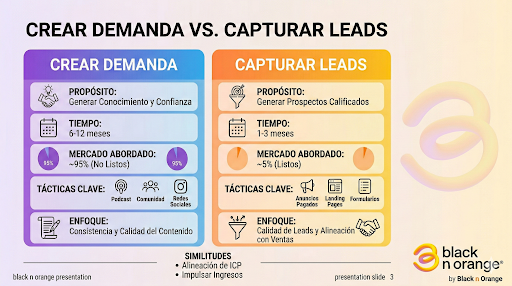

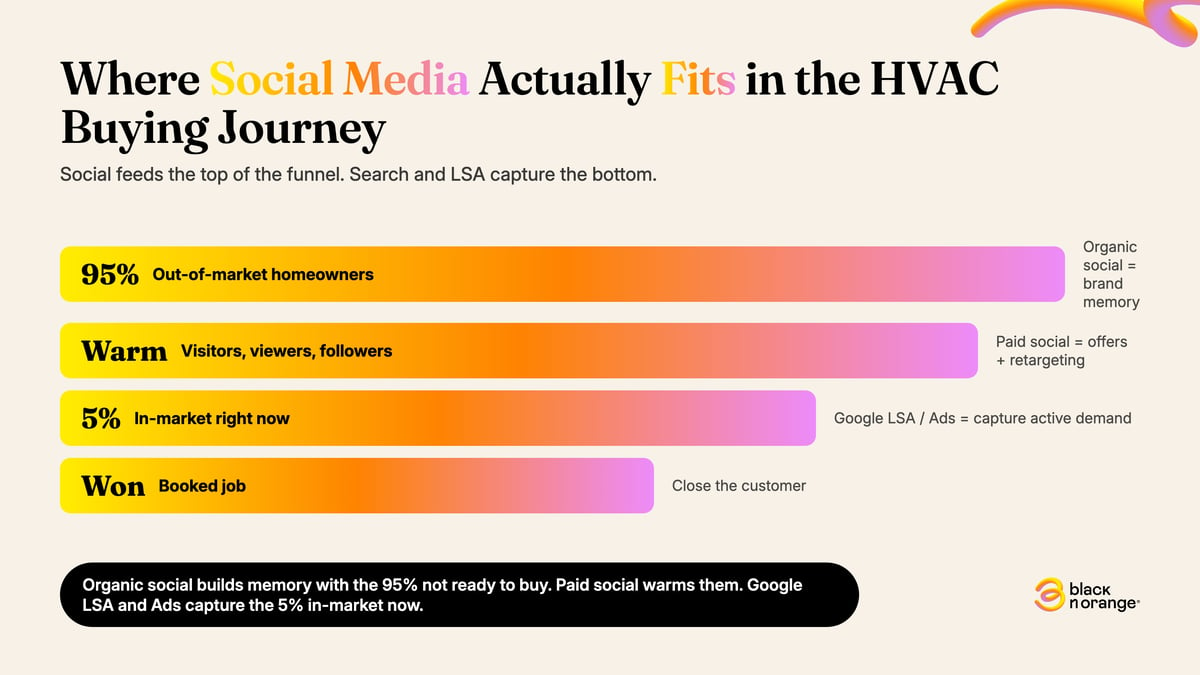
The honest answer: HVAC social media marketing is a demand generation tool, not a direct lead pipe. Organic social builds brand memory with the roughly 95% of homeowners whose system still runs — the same people who'll need a $10,000 replacement in two to eight years. Your job is to be the company they already recognize when the call for help finally happens.
Paid social works for a few specific things — seasonal offers, retargeting warm website visitors, and recruiting technicians. But cold-selling an AC replacement on Facebook to people who aren't looking for you is money down the drain. Social doesn't replace Google Local Services Ads for capturing emergency demand. It makes those channels cheaper and more profitable over time.
That's the whole thesis. The rest of this article is how to act on it without wasting your budget.
Does Social Media Generate HVAC Leads? (The Honest Answer)
It generates familiarity, which becomes leads later — through other channels. That distinction is the entire game.
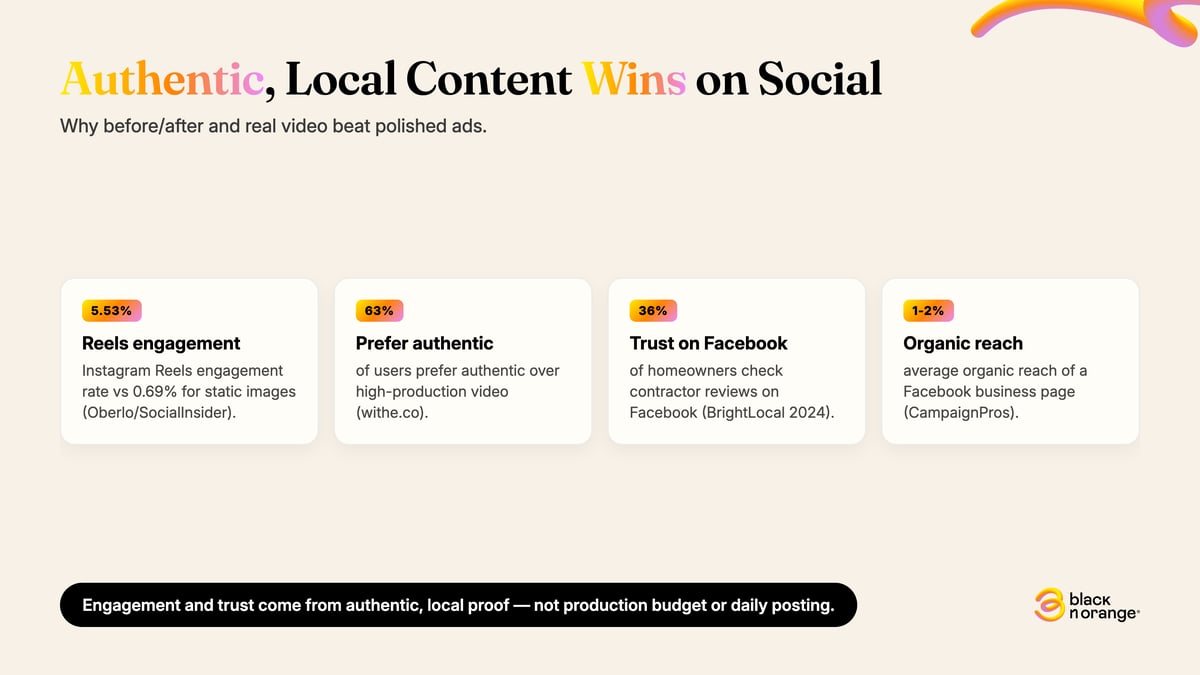
Here's the uncomfortable truth most agencies won't tell you: your Facebook business page probably reaches 1–2% of your own followers organically, down from around 16% in 2012 (CampaignPros). Posting without a paid strategy is close to talking to an empty room — and the few people in that room already know you.
So if you measure organic social by leads booked this week, it will always look like a failure. That's not the channel breaking. That's the wrong scorecard.
Leads are the last step of a demand system, not the first. Most of your market isn't ready to buy today, and no amount of posting changes that. What social can do is make sure that when a homeowner's unit dies, your name is the one already in their head.
If your social media results disappoint you the way shared-lead marketplaces disappoint most contractors, it's usually because you're asking the channel to do a job it was never built for. Part of the fix is understanding why chasing leads is the wrong starting point in the first place.
Organic Social Is Not a Lead Channel — It's a Brand Channel
An HVAC system lasts 15–25 years, and homeowners expect 16–20 (Carrier). Do the math on your service area: in any given month, the share of homeowners actively shopping for a replacement is tiny.
This is the 95:5 rule in its most extreme form — research from the Ehrenberg-Bass Institute shows that about 95% of potential buyers are out-of-market at any given time (Ehrenberg-Bass / marketingscience.info). For HVAC, the out-of-market window lasts years.
Demand capture vs. demand generation: Demand capture wins the homeowner at the finish line — they're already searching "AC repair near me," and Google Ads or LSA grab them. Demand generation wins at the starting gate — it builds the memory and trust that makes you the obvious choice when the race even begins. Organic social lives at the starting gate.
The 95% aren't ignoring you. They're just not ready. Your job is to stay visible and trusted until they are. That's not soft marketing — it's the only marketing that makes your capture channels efficient, because demand capture without prior demand generation means paying more to compete for less. Google Ads get expensive fast when nobody knows your brand.
The Content That Actually Moves the Needle: Before/After, Local Proof, and Team Posts
If organic social is a memory and trust channel, the best content is whatever proves you do great work in this neighborhood. Three types do almost all the heavy lifting.
1. Before/after job posts. This is the highest-ROI organic content type for HVAC, and most companies underuse it because they think they need a video crew. They don't — a technician with a phone camera is enough. One before/after post does five jobs at once: shows workmanship, signals local presence (this town, this street), creates social proof, educates homeowners on what a good install looks like, and earns saves and shares.
2. Local proof and reviews. A clean install at a recognizable local address says "we're real, we're here, your neighbor trusts us." Worth noting: 36% of homeowners would check a contractor's reviews on Facebook versus 56% on Google (BrightLocal 2024). Your social presence reinforces your Google review profile — it doesn't replace it.
3. Team and behind-the-scenes posts. A technician's day, the new service van, the crew at a job. This builds culture visibility (which matters for recruiting — more on that below) and makes a faceless company feel human.
On Instagram, format matters: Reels average a 5.53% engagement rate versus 0.69% for static images (Oberlo / SocialInsider). And don't over-produce — 63% of social media users prefer authentic, relatable video over high-production content (withe.co). A real tech explaining a real fix beats a glossy ad every time.
Should You Boost Posts or Run Real Facebook Ads?
This is the single most expensive mistake HVAC owners make on social, so let's be blunt.
Boosting a post is not advertising. It's paying Meta to show your content to whoever happens to be nearby — no real targeting, no conversion objective, no way to retarget, no offer architecture, and no way to measure ROI beyond likes.
A real Facebook Ads Manager campaign is a different product entirely. You define homeowner audiences by ZIP code, build custom audiences from website visitors or your customer list, send traffic to a specific offer landing page, and track measurable conversion events. One is vanity spend. The other is strategy.
The confusion between the two is the main reason HVAC owners say "Facebook doesn't work." It worked exactly as designed — boosting just isn't designed to do much. Boosting can occasionally supplement a campaign, but it is never the strategy.
When Paid Social Works for HVAC (and When It Doesn't)
Paid social works for HVAC in four specific situations:
- Seasonal offers. A spring tune-up or maintenance plan promo served to homeowners in a defined service area.
- Retargeting. Homeowners who visited your services pages but didn't book — they already know you, so the ad is a nudge, not a cold pitch.
- Recruiting. Targeting people with trade certifications or trade-adjacent job history (covered next).
- Lead magnets. "Is your system over 10 years old? Download our replacement guide" — to build an owned list you can nurture.
Where it doesn't work: cold-selling emergency repairs to people who haven't shown intent. That's what Google Ads and Local Services Ads are for — and the gap is real. Google Local Services Ads convert at about 31% lead-to-customer versus 12% for traditional PPC (LeadTruffle). Social and search aren't competitors. Social generates and warms; search and LSA capture. Run them together, not instead of each other.
How Lead Quality Differs by Channel
A homeowner clicking a Facebook ad for a $79 tune-up special is in a completely different mental state from someone who just Googled "emergency AC repair near me" at 3 PM on a 95-degree Texas afternoon.
Both are worth pursuing. But they need different funnels, different close rates, and different follow-up. Expecting a social lead to close like a search lead is what makes your cost per lead look terrible and your team give up on the channel. Tag the source, route it to the right sequence, and judge it against the right benchmark. If you're unsure what a good lead even looks like for your business, fix that before blaming a channel.

How to Use Social Media to Recruit HVAC Technicians
This is the most underplayed social win for HVAC — and arguably the highest-ROI use of paid social right now.
The technician shortage is structural, not seasonal. The BLS projects about 40,100 HVAC job openings per year through 2034 (U.S. Bureau of Labor Statistics), and over 50% of the current workforce is 45 or older and approaching retirement (The Access Group). Most contractors recruit off job boards alone and fight over the same desperate applicants.
Facebook and Instagram are where younger tradespeople actually spend time. Those behind-the-scenes posts — a tech's day, the team van, pay transparency, the new trucks — build culture visibility that a job listing never can. And the data backs it: social media is now the #1 sourcing method for employers, and video job posts increase application rates by 34% (Apollo Technical).
A Facebook recruiting campaign targeting trade certifications or related job history in your geography costs a fraction of a recruiter's fee and reaches people who are passively open to a better job — not just the ones already unemployed. That's a stronger pipeline.
Which Platforms Are Worth Your Time as an HVAC Contractor
Start where your homeowners and prospective technicians already are. 84% of U.S. adults use YouTube and 71% use Facebook (Pew Research 2025). These aren't niche platforms.
- Facebook — your anchor. Strong with homeowners 30–64 (80% of 30–49-year-olds, 74% of 50–64-year-olds use it, per Pew). Best for local proof, reviews, recruiting, and paid campaigns.
- Instagram — reaches younger homeowners and younger techs; this is where Reels and before/after video earn engagement.
- YouTube — the most influential platform for home improvement research; great for "how to know if your system is failing" educational content.
- Nextdoor — a passive local-proof channel worth a presence: 94% of neighbors value local recommendations and 72% have been influenced by a business recommendation (Nextdoor).
You don't need to be everywhere. Pick two or three and be consistently good — consistency is for familiarity, not for appeasing an algorithm.
What to Skip (So You Stop Wasting Time)
- Boosting posts as your "ad strategy." Already covered. Use Ads Manager or don't pay at all.
- Twitter/X. No evidence of ROI for residential HVAC. Skip it.
- LinkedIn for homeowner marketing. It's B2B. Useful only if you sell commercial or recruit office staff.
- Overproduced video. Authenticity outperforms polish. A glossy edit can actually underperform a phone clip of a real tech.
- Daily posting for its own sake. Post for memory and proof, not to feed a content quota.
- Treating social as a standalone fix. A channel without a system behind it is just noise. If you want to understand why most HVAC lead generation strategies fail over time, it usually comes down to tactics running in isolation — no connected demand engine.
- Lead marketplaces dressed up as "social." Buying shared leads isn't social media marketing, and it isn't the fix for an inconsistent pipeline.
How to Measure Social Media Without Chasing Vanity Metrics
Likes and follower counts don't pay payroll. Measure social as the demand-generation and recruiting channel it is.
Treat your CRM as a thermometer of interest, not a contact graveyard. Track signals, not just leads: which homeowners clicked your seasonal offer ad, who watched your video past 50%, who landed on your site from social. Those are intent signals worth nurturing.
Then measure what actually matters:
- Brand lift: branded search volume and direct site traffic over time.
- Retargeting performance: conversions from warm audiences, not cold reach.
- Recruiting: qualified applicants per dollar versus job boards.
- Assisted conversions: how often a closed job touched social before booking through search or LSA.
Social rarely gets "last-click" credit — and that's fine. It does its job upstream. If you only count last-click leads, you'll defund the exact thing that's making your search ads cheaper. The same principle applies to SEO: ranking on Google alone isn't enough if there's no brand recognition and trust already built when someone clicks.
This is where most HVAC marketing falls apart: it's a pile of disconnected tactics with no system tying signal to sale. Black n Orange has built that system for 200+ companies as a HubSpot Elite Partner, backed by a total satisfaction guarantee — so you can see which homeowners you're talking to, why they should choose you, and when sales should act.
Frequently Asked Questions
Does social media actually generate leads for HVAC contractors?
Indirectly. Organic social builds brand familiarity with homeowners who aren't ready to buy yet, so they choose you later through search or referral. Paid social can generate leads for seasonal offers and retargeting, but cold-selling emergency repairs on social rarely works — that's what Google LSA and Ads are for.
What's the difference between boosting a post and running a Facebook ad?
Boosting pays Meta to show your post to a broad nearby audience with no real targeting, no conversion goal, and no retargeting. A Facebook Ads Manager campaign lets you target homeowners by ZIP code, build custom audiences, send traffic to an offer page, and track conversions. Boosting is vanity spend; Ads Manager is strategy.
What should an HVAC company post on social media?
Before/after job photos, local proof and reviews, and team or behind-the-scenes content. These build memory, trust, and recruiting appeal — the three things social actually does well. Short, authentic Reels outperform polished, over-produced video. You don't need a video crew; a technician with a phone is enough.
Is paid social or Google Ads better for HVAC lead generation?
For capturing active demand, Google Ads and Local Services Ads win — LSA converts at roughly 31% lead-to-customer versus 12% for traditional PPC. Paid social wins for seasonal offers, retargeting warm visitors, and recruiting. They're not competitors; run social to generate and warm demand, search to capture it.
How can HVAC contractors use social media to recruit technicians?
Post culture content — a tech's day, the team, pay transparency, new trucks — and run Facebook ads targeting trade certifications or related job history in your area. Social is now the #1 sourcing method for employers, and video job posts raise application rates by 34%, reaching people passively open to a better job.
Which social platforms are worth an HVAC contractor's time?
Facebook first (most homeowners 30–64 use it), then Instagram for younger homeowners and Reels, YouTube for educational and home-improvement research, and Nextdoor for local proof. Skip Twitter/X and skip LinkedIn for homeowner marketing. Pick two or three and be consistently useful rather than spreading thin.
Stop Guessing Where Your Growth Is Stuck
Social media is one piece of a demand system — not the system itself. If your pipeline still feels unpredictable, the problem usually isn't the channel; it's that nothing ties your brand, your signals, and your sales follow-up together.
Find your growth restriction with BOOMS Score — a fast diagnostic that shows you exactly where your demand engine is leaking, free at brain.black-n-orange.com/en.
Before you spend another dollar chasing leads: find out if your business is actually ready to turn more leads into booked, profitable jobs.