
Why Most HVAC Lead Generation Strategies Fail Over Time
Most HVAC lead generation strategies fail over time because they are built entirely to capture the small slice of homeowners searching right now — roughly 5% of your market at any moment. Every contractor bids for that same 5%, so cost per lead climbs every year and quality drops as the pool gets shared. Meanwhile the other 95% — homeowners whose systems still run but will fail in one to eight years — never hear from you. So your pipeline resets to zero every season. The fix isn't another lead source. It's a demand system that builds memory with the 95% while you capture the 5%.
If that lands a little too close to home, keep reading. This isn't a tactics list. It's a diagnosis.
The Real Reason Your HVAC Lead Pipeline Keeps Breaking Down
You've probably been told your lead problem is a campaign problem. Wrong keywords. Bad bids. A weak agency. Slow call answering. So you optimize, you switch vendors, you add a channel — and a few months later you're back in the same spot, paying more for leads that close less.
That's because the problem was never executional. It's structural.
Almost every channel an HVAC owner uses — Google Ads, Local Services Ads (LSA), Angi-style marketplaces, SEO — does one job: it captures demand that already exists. It finds the homeowner whose AC just died and is typing "AC repair near me" at 2 p.m. in July. That's valuable. It's also a tiny, fixed pool that every competitor in your metro is fighting over at the same time.
When your entire strategy is capture, you're not building anything. You're renting attention by the click. And rent goes up.
You're Competing for the Same 5% — Over and Over
Here's the math that explains your rising cost per lead better than any campaign report.
Research from Professor John Dawes at the Ehrenberg-Bass Institute found that only about 5% of buyers in a category are in market at any given time. The other 95% are out of market (Ehrenberg-Bass / LinkedIn B2B Institute). For HVAC, the out-of-market share is even higher than most categories, because homeowners replace a system roughly every 10–15 years (ENERGY STAR). On any given week, the vast majority of homes in your service area simply don't need you.
Now layer on the competition. There are roughly 117,449 HVAC contractor businesses operating in the US (leads4build / BLS data), competing mostly on the same digital channels. Every one of them is bidding on the same narrow pool of in-market homeowners on your block.
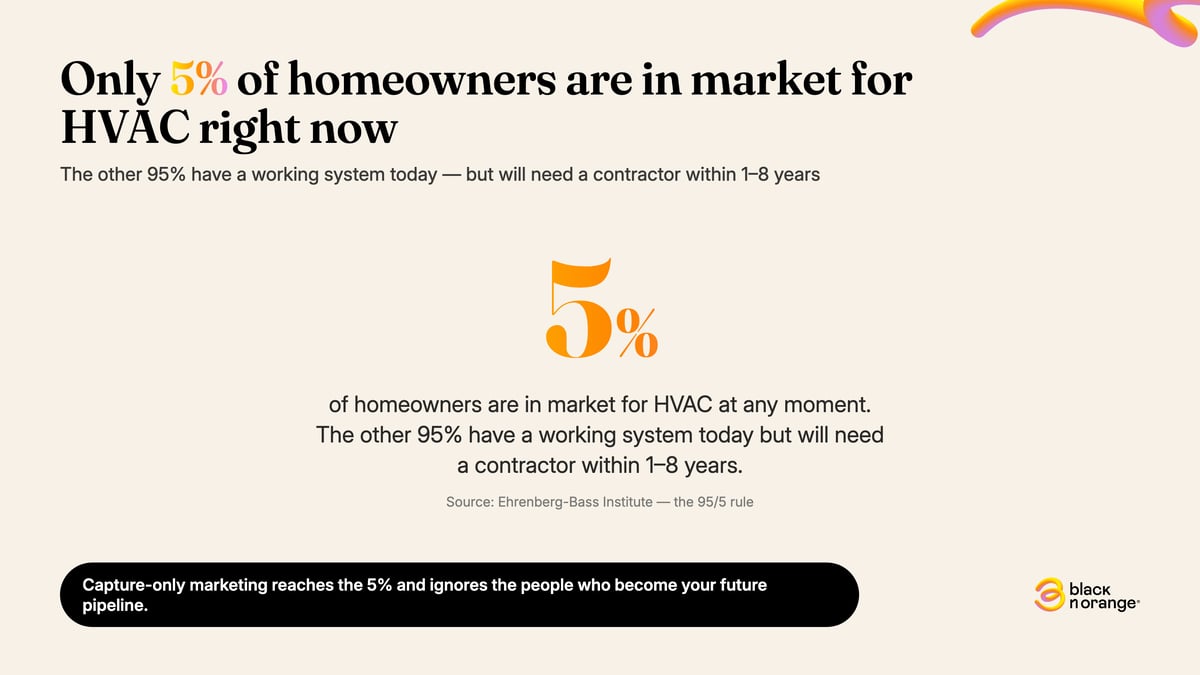
So when your CPL goes up 16% in a year, that's not a sign your campaign broke. It's a sign the auction for a fixed pool got more crowded. Rising cost per lead is a feature of demand capture, not a bug in your account.
How to know this is happening to you: if your cost per lead has risen 20% or more year over year without any change to your targeting or your service area, you're not running a worse campaign. You're experiencing demand-capture saturation.
Why Cost Per Lead Keeps Rising — and Sharing Makes It Worse
The benchmarks back this up. Median Google Ads cost per lead for AC installation and repair now sits around $127.74, and around $129.02 for heating and furnaces. Home-services CPL rose about 10.5% year over year, and CPL increased for 69% of home-services businesses (LOCALiQ 2025 Search Ad Benchmarks).
Even LSA — the "better," exclusive-lead channel — isn't immune. HVAC cost per lead on Google Local Services Ads rose from roughly $50 in 2023 to about $80 in 2025, a ~60% jump in two years (The Media Captain LSA data).
Marketplace leads are worse than the sticker price suggests, because they're sold to three to eight contractors at once (Workzen contractor lead analysis). Pay $50–$75 for a shared lead, win one in four, and your true cost per booked job is $200–$300 before you've paid for a single hour of technician or sales time.
And the pressure is about to get heavier. The HVAC sector is "characteristically fragmented," and PE-backed roll-ups are buying up local contractors — Airtron sold for $500M at 8.6x EBITDA (PKF O'Connor Davies HVAC Update, Fall 2024). Those consolidators walk into your market with budgets you can't outbid. If you're competing for the same 5% on the same channels, that arms race only ends one way.

Why Adding Another Lead Source Doesn't Fix the Problem
This is the move almost every owner makes. CPL on Google Ads climbs, so you add Thumbtack. Angi gets noisy, so you turn on LSA. SEO stalls, so you buy more shared leads.
Here's the uncomfortable part: every one of those is the same kind of tool. They're all demand-capture channels fighting for the same in-market 5%. Adding a fourth or fifth one doesn't change the fundamental problem — it just spreads your spend across more auctions for the same shrinking pool. If you're evaluating whether a lead generation partner can actually help you escape this cycle, read what no one tells you about HVAC lead generation companies before you sign another contract.
The number of channels you run has almost nothing to do with whether your pipeline is healthy. What matters is the ratio of demand generation to demand capture. If 100% of your marketing is capture, your pipeline will always reset to zero the moment you stop spending — no matter how many channels you stack.
This is the structural reason your HVAC pipeline stays inconsistent and seasonal. It's not really a seasonality problem. It's a brand-memory problem dressed up as one.
What Happens When You Build Your Business on Rented Attention
Think about what the 95% experience.
A homeowner sees your Google Ad in July, but their system is fine, so they scroll past and forget you in an hour. In October the furnace starts clanking. Who do they call? Whoever they remember. And if the only time you ever showed up was while they were briefly in market, they almost certainly never registered you at all.
Professor Dawes puts it bluntly: "If there are potential buyers out there who basically know nothing about us, they have almost zero chance of buying from us."
Memory takes repetition, not a single impression. People generally need to encounter a brand many times across a window before it sticks. Sporadic seasonal campaigns — even expensive ones — build recognition that evaporates between seasons. So you pay to be remembered, then let the memory fade, then pay again next summer. That's the treadmill.
Meanwhile the channels that decay your capture strategy keep getting stronger. AI Overviews now appear in roughly 30% of searches and cut organic click-through by about 35% when present; 64% of Google searches end without a click (Search Engine Land / Graphite). A brand that only exists in the click layer loses ground every quarter as homeowners get answers without clicking anyone.
The Difference Between a Lead Source and a Demand System
Let's define the two, because the whole fix lives in this distinction.
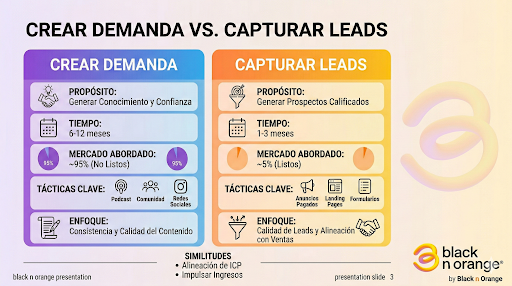
A lead source captures demand. It's a channel you rent to intercept the 5% who are searching right now. Turn off the spend, and the leads stop the same day. It's transactional, competitive, and it gets more expensive over time.
A demand system generates demand and then captures it. It builds memory, preference, and trust with the 95% who aren't ready yet — through reviews, video, useful content, email and SMS to your existing base, and a consistent presence — so that when their system fails, you're the name they already know. Then it captures the 5% on top. It compounds. The work you did last year still pays this year.
Leads aren't the start of marketing. Leads are the last step of a demand system. When you treat them as the starting point, you're forever buying the moment of intent at auction. When you treat them as the output of a system, the moment of intent increasingly tilts your way for free.
This also reframes your CRM. Most HVAC companies use it as a contact graveyard: chase the lead for 72 hours, win the job or forget the name. But the homeowner who asked for a quote in October and didn't buy is pre-sold on the category and likely to replace within 12–36 months. A CRM used as a thermometer — tracking engagement, maintenance-plan renewals, aging systems — turns that "dead" database into your cheapest pipeline. Especially when acquiring a new HVAC customer costs 5–7x more than retaining one (ServiceFusion), and the average HVAC customer is worth more than $15,000 over a 15-year lifecycle (FieldEdge).
What an HVAC Demand System Actually Looks Like
It's a sequence, not a channel swap. Don't start with the channel — start with the buyer.

- Segment. Decide which homeowners you actually want — neighborhoods, system age, replacement vs. repair — instead of buying every lead a marketplace will sell you.
- Message. Give homeowners a reason to choose you over the contractor down the street. Lead volume without positioning just creates noise.
- Generate demand with the 95%. This is the part capture-only owners skip. Consistent reviews matter here — 75% of consumers regularly read reviews for local businesses, and 88% would use a business that responds to all of them (BrightLocal 2024). Add short-form video and a consistent social presence along with helpful seasonal content and email/SMS to your installed base. This is what builds the memory that makes you the default call.
- Capture the 5%. Keep your LSA, Google Ads, and referral engine running — but now they're converting a market that already knows you, so they convert better and cost relatively less. For a deeper look at how to make paid HVAC advertising actually pay, that breakdown walks through which channels earn their cost and which don't.
- Use the CRM as a thermometer. Track who engaged, who has a plan, whose unit is aging into the replacement window.
- Hand off to sales fast when a high-intent signal fires.
Notice that lead generation is the last step. Everything before it is why the lead is cheaper, warmer, and more loyal when it arrives.
This is the difference between a pipeline that resets every season and one that compounds. It's also the work we do with 200+ companies as a HubSpot Elite Partner — diagnosing the demand-capture addiction first, then building the system, backed by a total satisfaction guarantee. Not because a system is a magic switch — it isn't — but because it's the only thing that stops the treadmill.
If you want to go deeper on specific symptoms, read our breakdowns of why your pipeline fluctuates, what actually makes a good HVAC lead, and why asking "how do I get more leads" is the wrong question to begin with.
FAQ: HVAC Lead Generation Strategies
Why do HVAC lead generation strategies stop working over time?
Because they only capture the ~5% of homeowners in market right now. Every contractor bids for that same pool, so cost per lead rises yearly and quality drops as leads get shared. Without demand generation for the other 95%, your pipeline resets each season instead of compounding.
What's the difference between demand generation and demand capture for HVAC?
Demand capture intercepts homeowners already searching (Google Ads, LSA, marketplaces) — you rent it, and it stops when spend stops. Demand generation builds memory and preference with homeowners who aren't ready yet, so you're the name they call when their system fails. You need both, but capture alone decays.
Why does my cost per lead keep rising on Google Ads and lead marketplaces?
Because you're competing for a fixed pool of in-market buyers against more contractors and PE-backed roll-ups every year. HVAC Google Ads CPL rose ~10.5% YoY and LSA cost per lead jumped ~60% in two years. It's structural competition, not a broken campaign.
Why doesn't adding another lead source fix inconsistent HVAC leads?
Because every lead source is a demand-capture tool fighting for the same 5%. Stacking Thumbtack on Angi on LSA spreads spend across more auctions for the same shrinking pool. Pipeline health depends on your ratio of demand generation to capture — not your channel count.
What should I do instead of buying leads from Angi or HomeAdvisor?
Don't abandon capture — rebalance. Build demand with the 95% through reviews, video, content, and nurture to your existing base so homeowners remember you before their unit fails. Then keep capturing the 5% on top. Use your CRM as a thermometer, not a graveyard.
Stop Renting. Start Building.
If your cost per lead keeps climbing and your pipeline keeps resetting, the problem isn't your last campaign — it's that you're 100% in the capture business. The fix is a demand system that earns preference with the 95% while you keep capturing the 5%.
Find your growth restriction with BOOMS Score — a free diagnostic that shows exactly where your demand system is leaking. Get your BOOMS Score.
Before you spend another dollar chasing leads: find out if your business is actually ready to turn more leads into booked, profitable jobs.