
HVAC Website Design That Books Jobs
Great HVAC website design isn't measured by how it looks — it's measured by how many homeowners it turns into booked jobs. A high-converting HVAC website does four things fast: it loads instantly on a phone, makes it obvious what you do and where, builds trust with real reviews and proof, and makes booking a call effortless. Behind all of it sits a CRM that tells you which visits actually became revenue. Miss any of those, and you have an expensive brochure, not a salesperson that works 24/7.
Here's how to design (or fix) a site that earns its keep.

Your Website Has One Job: Book the Homeowner Who's Ready Now
When a homeowner lands on your site, they're usually in one of two states: their system just failed and they're stressed, or they're researching a replacement and comparing two or three companies. In both cases they decide in seconds whether you're trustworthy and easy to reach.
That's the lens for every design choice. Not "does this look modern" but "does this help a stressed homeowner book us faster than the competitor's site." Pretty is fine; pretty-and-converting is the goal. This is the same trap behind why most lead generation efforts fade over time — companies invest in the surface and ignore the system underneath.
The Four Pillars of an HVAC Website That Converts
1. Speed
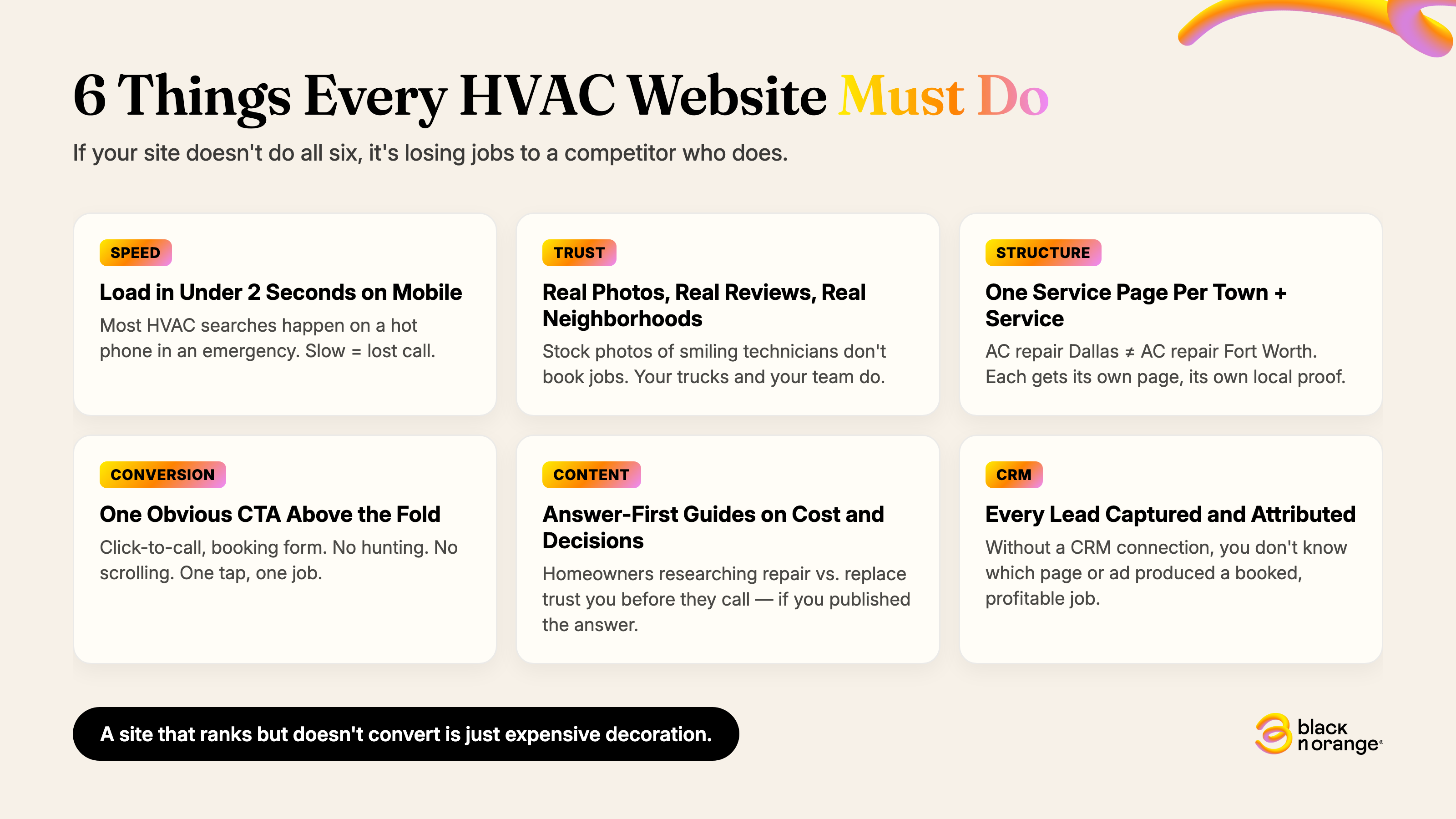
Most "AC not cooling" searches happen on a phone, often in a hot house, often impatient. If your site takes more than a few seconds to load, you lose the call before the homeowner ever sees your reviews. Speed isn't a nice-to-have; it's the first conversion factor. Compress images, cut bloated plugins, and test on a mid-range phone over cellular, not your office Wi-Fi.
2. Clarity
Within five seconds, a visitor should know: what you do (AC, heating, IAQ), where you do it (your towns), and how to get help (call or book). Lead with that. Bury it under a slideshow and a mission statement, and you've made the homeowner work — so they leave.
3. Trust
Homeowners are letting a stranger into their house. Reduce that risk on the page: real photos of your team and trucks (not stock images), genuine recent reviews, licensing and insurance, manufacturer certifications, and a clear local presence. Trust signals are what tip a comparison shopper toward you.
4. Easy booking
Make the next step impossible to miss. A click-to-call button that's always visible on mobile, plus a short booking form for people who'd rather not call. Don't ask for ten fields — name, phone, service needed, and ZIP are enough to start a real conversation.
Why "Looks Great" Isn't the Same as "Books Jobs"
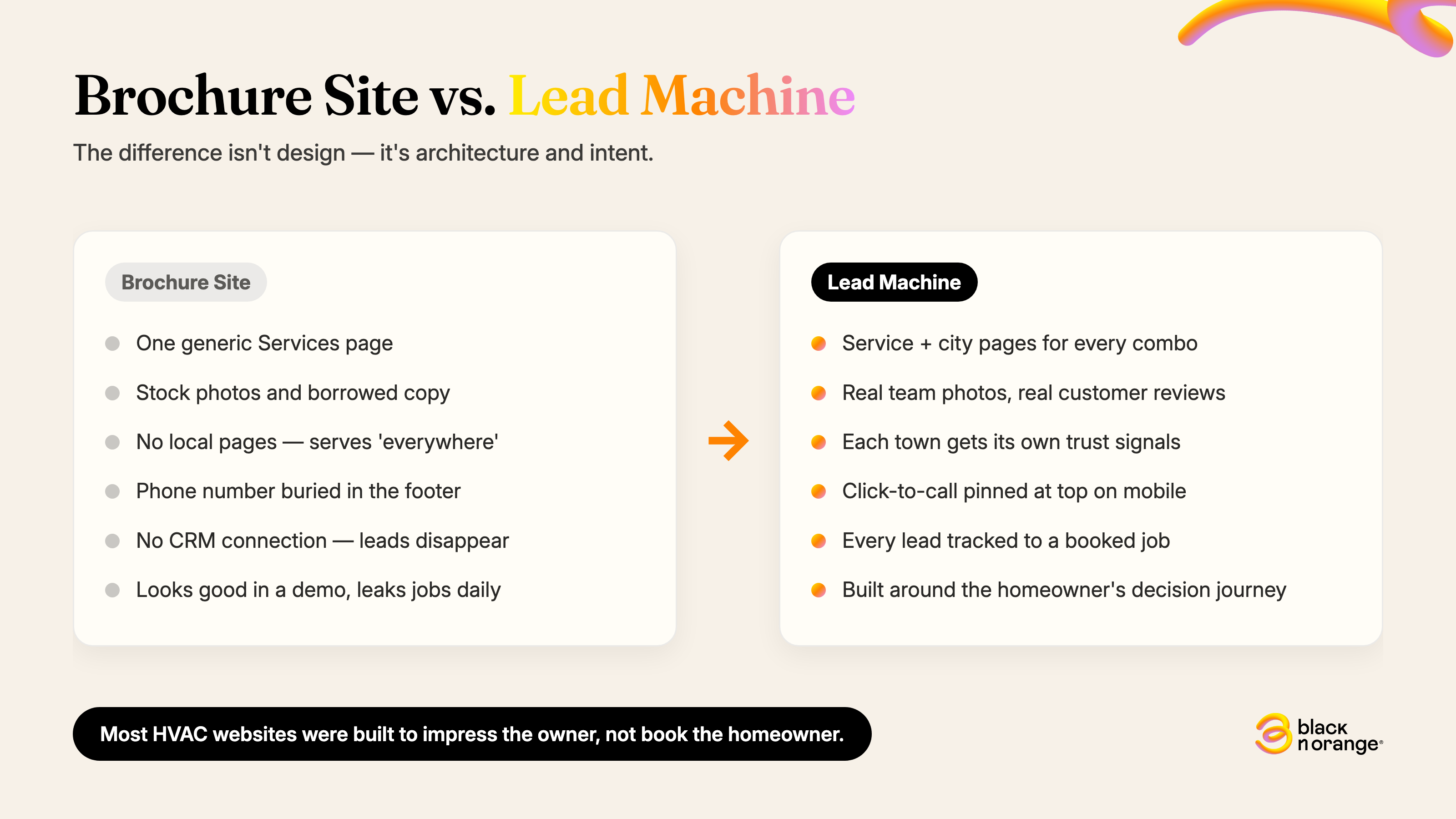
Plenty of HVAC companies pay for a stunning redesign, see no change in booked jobs, and conclude "marketing doesn't work." The site looked better; it just wasn't built to convert or measure.
The disconnect is almost always the same: the website was treated as a standalone art project instead of one piece of a booking system. It wasn't fast on mobile, the call-to-action was soft, there were no trust signals above the fold, and — critically — nothing tracked which visits turned into calls. You can't improve what you can't see. This is why we treat website design and lead generation as a single problem, the same way a site full of leads that don't book jobs points to a system gap, not a traffic gap.
The CRM Behind the Website (The Part Nobody Photographs)
A website that books jobs without a CRM behind it is a leaky bucket. Calls come in, forms get filled, and then... where do they go? Who follows up on the homeowner who filled a form Friday night but didn't pick up Saturday?
Connect your site to a CRM and call tracking so every form fill and call becomes a record you can follow up on, and every booked job can be traced back to its source. That's how you learn which pages, which towns, and which services produce the most profitable work — and stop guessing. It's also what smooths out the swings behind an inconsistent pipeline: the leak isn't always demand, it's follow-up.
Website Design and Getting Found: They Reinforce Each Other
Good design isn't only about the visitors you already have — it shapes whether you get found at all. A fast, mobile-friendly, well-structured site is easier for Google and AI tools to read, rank, and recommend. As covered in the complete HVAC SEO guide, the same technical fundamentals that please homeowners (speed, clarity, structure) are what make you eligible to appear in search and in AI answers.
The reverse is true too. If you're spending on paid ads but sending that traffic to a slow, confusing site, you're paying for clicks that bounce. Fix the destination before you raise the ad budget.
Common HVAC Website Design Mistakes
- Slow load on mobile. The most expensive mistake, because it happens before anyone sees your value.
- Hidden or hard-to-tap phone number. The call should never be more than one tap away.
- Stock photos instead of real proof. Homeowners can tell, and it erodes trust.
- No clear service area. If a visitor can't confirm you serve their town, they leave.
- A redesign with no tracking. If you can't measure which visits book jobs, you're flying blind.
- Too many form fields. Every extra field costs you leads.
How to Know If Your HVAC Website Is Costing You Jobs
Ask yourself:
- On your phone, how fast does your homepage load over cellular?
- Could a stranger tell, in five seconds, what you do and where?
- Are your reviews and real photos visible without scrolling far?
- Is the phone number one tap away on every page?
- Can you say which calls last month came from your website?
If you hesitated on more than one, your site is leaking jobs — and the fix is usually cheaper than the leak.
Frequently Asked Questions
What makes an HVAC website convert visitors into booked jobs?
Three things working together: speed (it loads fast on a phone), clarity (a homeowner instantly knows what you do, where, and how to book), and trust (real reviews, real photos, licensing). Add a phone number that's always one tap away and a simple booking form, and you've covered most of what moves a visitor to a call.
How much should an HVAC website cost?
Less than you think to build, more than you think to make it actually produce jobs. A clean, fast, trustworthy site is the table stakes; the value comes from connecting it to call tracking and a CRM so you can see which visits turn into revenue. Spend on the system, not just the skin.
Do I need a new HVAC website or just improvements?
If your current site loads fast, works on mobile, clearly states your services and service area, shows real reviews, and makes booking obvious, you likely need improvements, not a rebuild. If it's slow, hard to read on a phone, or you can't tell which calls it produces, a rebuild usually pays for itself.
Should my HVAC website have online booking?
Yes, alongside a prominent click-to-call. Some homeowners want to call immediately; others, especially for non-emergencies and maintenance, prefer to book a slot without talking to anyone. Offering both captures both, and a booking form feeds your CRM with a real lead you can follow up.
Does website design affect HVAC SEO and AI visibility?
Heavily. A fast, mobile-friendly, well-structured site with clear content is easier for Google and AI tools to read and recommend. Poor design — slow load, confusing structure, blocked crawlers — hurts both your rankings and your odds of being cited when a homeowner asks AI for the best local company.
See Where Your Website Is Leaking Jobs
Your website is one piece of a bigger machine: getting found, getting chosen, and turning that into booked, profitable jobs. If booked jobs aren't growing the way your traffic suggests they should, the restriction is somewhere in that machine — and it's worth finding before your next redesign.
Run the BOOMS Score diagnostic to pinpoint exactly where your growth is stuck and what to fix first.
Before you spend another dollar chasing leads: find out if your business is actually ready to turn more leads into booked, profitable jobs.